
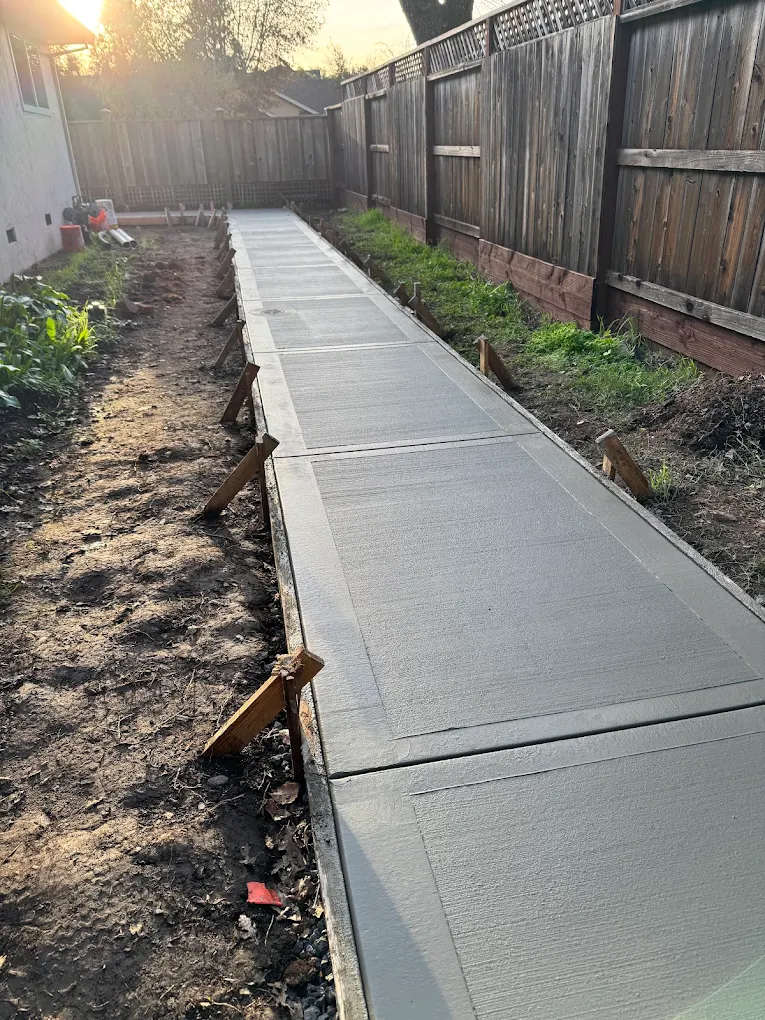
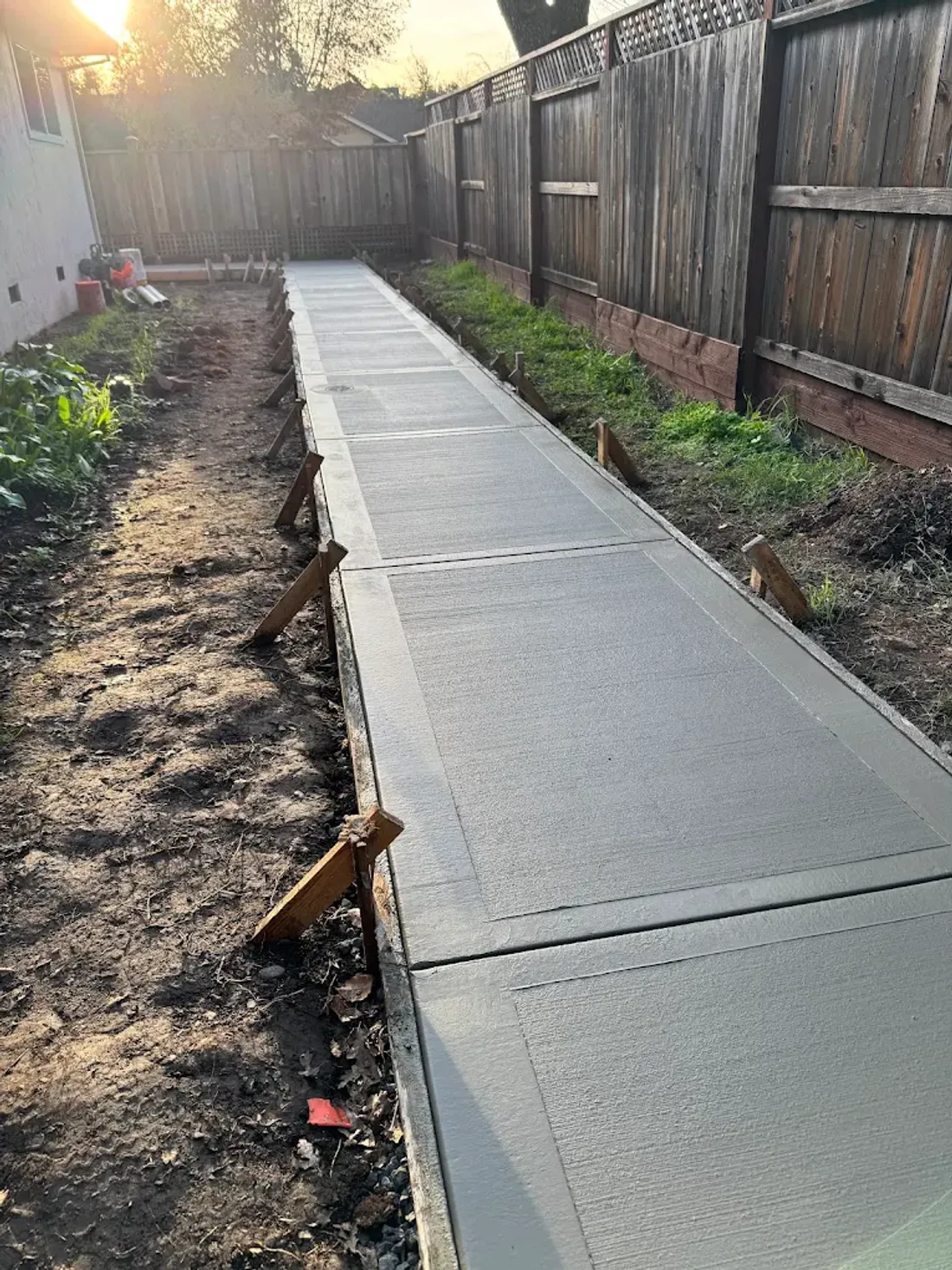
The word “sidewalk” can mean the path beside your house or the public walking route along the street. Both may be made of concrete. Both may have a damaged panel. That does not mean the repair process is the same.
Before asking someone to replace a section, identify which surface you are talking about and where the proposed work stops. The location can affect approvals, required details, responsibility, and the way people need to get around the work area.
For a Windsor or Sonoma County property owner, this distinction is a useful first step. It keeps a seemingly small repair from being priced as ordinary backyard work when it actually touches a public connection or another set of requirements.
Start with a photograph of the whole route
A close-up of a raised edge shows the immediate concern, but it may leave out the most important location information. Take a wider view that includes the street, driveway, property entrance, or side yard as appropriate.
Mark the area you believe needs work. Then show what lies at both ends: another panel, a driveway crossing, a step, a ramp, a gate, or a door. These connections can influence the repair boundary and the finished levels.
If you are unsure whether a particular strip lies within the public right-of-way, say so. A fence line or the fact that you maintain the area does not by itself answer every boundary question. The project should establish the relevant location and jurisdiction before assuming how the repair can proceed.
Understand the private-path conversation
A walkway entirely within a yard is usually discussed in terms of its intended use and connections. Who uses it? Does it carry wheeled bins, garden equipment, or access to a main entrance? Are there gates, narrow turns, or changes in level?
A repair should make sense for that route. Replacing a low panel may improve one spot but leave an awkward step at the next surface if the surrounding levels are ignored. The contractor needs to look beyond the visible defect.
This is also a chance to consider whether the existing layout is worth keeping. If the path is too narrow for its everyday use or follows an inconvenient route, a broader replacement may be worth comparing. That is a design choice to evaluate, not an automatic reason to enlarge every repair.
Recognize the public-sidewalk boundary
Work in the public right-of-way can involve local approval and construction requirements. In Windsor, the Town’s encroachment-permit page is a starting point for applicable work. Use the actual address and proposed scope when confirming the process.
The important planning lesson is that a sidewalk in front of a home is not automatically an ordinary private-yard project. The repair may affect a route used by the public and may need details established by the responsible authority.
Ask who will confirm the requirements, obtain any necessary approval, and coordinate required inspections. Those responsibilities should be visible in the estimate or project plan. A small area of concrete can still need a clearly assigned process before construction begins.
Responsibility and construction scope are separate questions
Who is responsible for addressing a sidewalk condition and what work is required are related questions, but one does not automatically answer the other. The owner may need information from the local authority before the construction scope is settled.
For example, Santa Rosa publishes sidewalk responsibility information for property owners. That city-specific guidance should not be treated as a rule for every Sonoma County address. Each project needs its own jurisdiction checked.
When requesting an estimate, share any notice, approved detail, or correspondence you have received. The contractor can then review the construction request against the actual information rather than guess what a general statement about sidewalk responsibility is supposed to require.
Describe the problem in terms of use
A crack, a raised joint, a broken edge, and a low panel may affect people differently. Tell the contractor what you are concerned about and what happens when the route is used.
Perhaps a wheeled bin catches at one point. Perhaps the path holds water near the gate. Perhaps a broken corner leaves an awkward edge at the driveway. These observations help establish the practical goal of the work.
Do not select the repair method before the condition is assessed. Grinding, patching, replacing a panel, and rebuilding a larger section are different approaches. Their suitability depends on the concrete, the height difference or damage, the surrounding site, and any applicable requirements. A request for “the cheapest patch” may skip the question of whether it will produce the result you need.
Look for conditions that may keep affecting the concrete
Roots, water, ground support, and nearby construction can be relevant to an uneven or damaged walkway. Photograph the surrounding area and share what you know about when the condition appeared or changed.
Avoid treating those observations as permission to cut roots, excavate beside utilities, or alter drainage yourself. The contractor can identify what needs further review and whether another professional should be involved.
A repair estimate should distinguish the concrete work from any related cause that remains outside it. If the proposal replaces a panel but does not address a known contributing issue, ask about that limitation. The goal is to understand the usefulness of the repair, not to assume that fresh concrete automatically resolves every surrounding condition.
Ask why the repair stops where it does
The practical removal boundary may follow existing joints or include more than the smallest damaged area. Ask the contractor to show the proposed limits and explain the connection to the concrete that remains.
This question is particularly useful when two estimates differ. One may cover a partial treatment while another includes panel replacement or work at a nearby transition. Without understanding those boundaries, the totals do not describe the same job.
Also review appearance. New concrete may differ from the older panels beside it. A clear, deliberate boundary can make the result understandable, but it does not guarantee an exact match in color or texture. Discuss what you can reasonably expect before selecting a limited replacement for visual reasons.
Include driveway crossings and entrances
A walkway that crosses a driveway has more than pedestrian use around it. Vehicle movement, the driveway approach, and the street connection may all influence the details. The repair should be considered with those relationships.
Similarly, a path meeting steps or an entry landing has fixed levels and clearances to respect. Changing one panel can affect the next movement toward the door. A useful review follows the route from one end to the other.
For work concentrated at a driveway connection, our concrete apron page may help you describe the scope. For an entrance, steps and entryway work may need to be discussed together rather than treated as unrelated additions.
Keep access in the construction plan
A walkway may be the main route into a home or business. Tell the contractor who relies on it and whether an alternative exists. The interruption can include demolition, preparation, placement, and curing, not just the time the crew is actively working.
Where a public route is involved, temporary access and protection may have specific requirements. Establish who is responsible for that part of the project. Do not assume a casual barrier or improvised detour is enough for every setting.
For a private path, the household still needs a practical plan. Pets, deliveries, bins, and visitors may use the same route. A clear explanation of when the area is unavailable helps avoid someone crossing new concrete because they did not understand the schedule.
Gather the information that makes an estimate useful
A focused request can include:
- The property address and the exact walkway location.
- A wide photograph and closer views of the damage.
- Approximate dimensions of the affected area.
- Connections to driveways, steps, doors, or ramps.
- Any known changes over time or previous repairs.
- City notices, approved details, or other relevant correspondence.
- Access needs during the work.
- The result you want the repair to achieve.
If you do not know whether a permit or a particular standard applies, identify that as a question. A useful inquiry does not require you to arrive with all the regulatory answers. It requires enough location and scope information to ask the right authority and define the next step.
Read the proposal as a complete route
When the estimate arrives, picture walking through the finished area. Does the repaired section meet the adjoining surfaces? Are any gates, landings, or driveway edges still unresolved? Is surrounding restoration assigned?
Check the written limits of removal, preparation, finish, cleanup, and related work. If approval or inspection responsibilities were discussed, make sure the plan still reflects that conversation. If the proposed method changed after a site review, ask for the scope to describe the current recommendation.
This review is more useful than focusing on a single square-foot rate. A sidewalk repair is successful when the finished connection works and the agreed process is complete, not merely when a certain amount of new concrete has been placed.
Begin with location, then choose the repair
A private walkway and a public sidewalk may share a material, but they can have different planning requirements. Identifying the surface, its connections, and its jurisdiction helps the contractor propose work that belongs in the actual setting.
Hard Stone Concrete discusses sidewalk repair and new walkways in Windsor and across Sonoma County. Contact us with the location, photographs, and any information already supplied by the local authority.
The first useful decision is where the project begins and ends. The repair method follows from that clearer picture.